
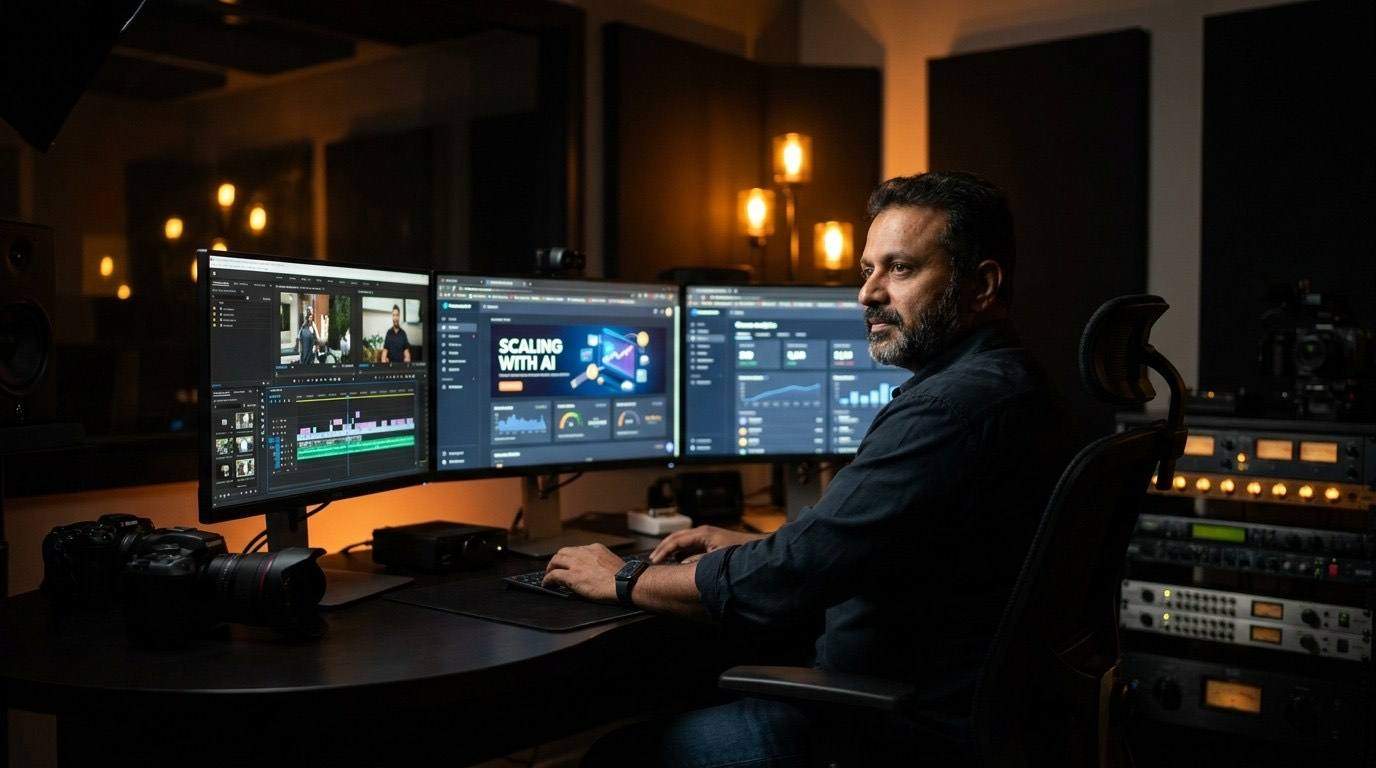
Course Video Production in India: Complete Guide for Online Coaches 2026
You have the knowledge. You have the curriculum mapped out. You have the students waiting. The one thing standing between you and a published course that generates revenue while you sleep is the video production.
For most online coaches in India, this is where the journey stalls. The options feel overwhelming — do you buy a camera and shoot yourself? Hire a local video company? Use one of the new AI tools? And underneath all of that is the bigger question: how do you produce videos that your students will actually watch all the way through, that position you as a credible expert, and that you can afford without spending the next six months of course revenue before you have earned a single rupee?
This guide answers all of those questions. We will cover the types of course videos you need, your production options and what each actually costs, how AI is reshaping the economics of course production in India, and a practical checklist to make sure you are ready before you hit record.
The 5 Types of Course Videos Every Online Coach Needs
Not all course videos serve the same purpose. Understanding the different types helps you plan your production properly — and avoid the common mistake of recording 10 hours of content without the assets that actually sell the course or retain the student.
1. Course Intro / Welcome Video (2–4 minutes)
This is the first thing your student watches after purchasing. Its job is to build confidence in their decision, explain what they are going to learn and why it matters, and set expectations for how the course works. A strong welcome video reduces refund requests and increases course completion rates. It should feel warm, personal, and clear. Talking-head format works well here — this is about human connection, not production polish.
2. Module / Lesson Videos (5–20 minutes each)
The core of your course. Lesson videos vary in format depending on the subject matter. Business, marketing, and skills-based courses often work well as talking-head segments with supporting slides or screen recording. Practical or visual topics — cooking, fitness, design, language learning — need demonstration footage. For conceptual frameworks and models, animated explainers consistently outperform talking-head content in comprehension and completion rates.
3. Course Promo / Sales Video (60–120 seconds)
This lives on your sales page and runs as a paid ad. It is arguably the highest-leverage video you will produce because it is the one that generates the revenue to fund everything else. A good course promo addresses the problem your student is facing, introduces you and your credibility, describes the transformation the course delivers, includes social proof, and ends with a clear CTA. This is one video worth investing in properly.
4. Student Testimonial Videos (45–90 seconds each)
Social proof in video format converts far better than text testimonials. Even a well-edited recording from a student's phone, cleaned up with good audio and captions, is more persuasive than a five-star written review. Aim for 3–5 testimonial videos before launch. Ask students to speak to the specific result they achieved and what they would say to someone on the fence about enrolling.
5. Short-Form Promotional Content (15–60 seconds)
Instagram Reels, YouTube Shorts, and LinkedIn clips that drive traffic to your sales page. The most effective approach is to repurpose the best moments from your module videos — a powerful insight, a counterintuitive framework, a step from your signature method — edited into a standalone short-form piece. This keeps your social presence active without creating content from scratch every week.
Your Production Options: DIY vs Agency vs AI
Option A: DIY Production
The appeal is obvious — no agency fees, complete creative control, and the authentic quality of a real person in a real space. The reality is more complex. Good DIY production requires a reasonable camera (₹30,000–₹80,000 for a mirrorless), a decent microphone (₹5,000–₹15,000), basic lighting (₹8,000–₹20,000), and editing software (₹1,500–₹5,000 per month). That is a hardware investment of ₹45,000–₹1.15L before you have produced a single video.
Beyond equipment, there is time. Most first-time course creators underestimate how long editing takes. A 10-minute lesson video typically requires 2–4 hours of editing for someone who is not a trained editor. For a 20-module course, that is 40–80 hours of editing alone. If your time is worth anything as a coach, the economics of DIY break down quickly.
Best for: Coaches with very lean budgets, high technical confidence, and genuinely available time.
Option B: Traditional Video Agency
Hiring a professional video production company gives you high-quality output without the learning curve. A studio day, crew, post-production, and graphics for a 10-module course in India typically costs ₹2.5L–₹6L depending on city and complexity. Turnaround is 3–6 weeks.
Best for: Established coaches with proven course revenue, launching a flagship premium product, or producing once-and-done evergreen content.
Option C: AI-Augmented Production
This is the option that has changed the calculation for most online coaches in India in the last 18 months. An AI video production agency uses AI tools for visual generation, voiceover, motion graphics, and editing automation — dramatically reducing both cost and turnaround time while maintaining the production quality that converts.
A 10-module course package with AI-augmented production in India typically costs ₹80,000–₹1.8L, with a turnaround of 7–14 days. For course creators launching their first or second product, or iterating quickly based on student feedback, this option delivers professional quality at a price that makes financial sense from the first cohort.
Best for: Coaches launching their first course, scaling from 1 to 5 courses, or needing fast turnaround without sacrificing quality.
How AI Is Transforming Course Production in India
The most significant shift in course production right now is not any single tool — it is the collapse of the gap between "what a solo coach can afford" and "what a professional production looks like."
Three years ago, a course with professional motion graphics, animated explainers, and polished video segments was the territory of funded EdTech platforms with full-time content teams. Today, a coach with a strong curriculum and the right production partner can launch a course that looks and feels indistinguishable from a ₹50,000 programme on a major platform — for a fraction of the cost.
Specific ways AI is changing the workflow for Indian course creators:
- Multilingual voiceover: AI voice tools now produce natural-sounding Hindi, Tamil, Kannada, and Bengali voiceovers from an English script, opening regional markets without additional recording sessions.
- Animated explainers at scale: Concept animation that once required a dedicated motion designer for 2–3 days per video can now be produced in hours using AI-assisted animation workflows.
- Automated captions and subtitles: Essential for accessibility and for the majority of learners who watch on mobile. AI transcription has made this essentially zero-effort.
- Rapid iteration: When a student cohort flags that a particular explanation is confusing, AI production allows a re-recorded or revised module to be turned around in 48–72 hours instead of 2 weeks.
Pre-Production Checklist: Before You Start Recording
Rushing into production without this groundwork is the most common and costly mistake coaches make. Run through this list before any camera turns on.
- Curriculum finalised: Every module has a clear learning objective. You know exactly what each video needs to cover.
- Script or outline complete: Full scripts are best for promo and intro videos. Structured outlines work for module content where you want to sound natural.
- Visual references gathered: Know which modules need slides, which need screen recording, and which need explainer animation. Collect any examples, diagrams, or frameworks you want recreated.
- Brand identity defined: Colours, fonts, logo, and the overall visual tone of your course platform. Production quality is undermined by inconsistent branding.
- Student testimonials collected: If you have run a beta cohort, get testimonial recordings before production wraps. This is the most overlooked step.
- Platform and technical specs confirmed: Know where the course will be hosted (Teachable, Graphy, Thinkific, your own site) and what video specifications the platform requires.
- Launch date set: Work backwards from your launch. If you have a live cohort starting date, production must be complete at least two weeks prior.
If you are working with a production partner, share this checklist with them in your first briefing call. A professional EdTech video production team will walk you through it regardless — but coming prepared cuts your briefing time in half and significantly reduces the risk of reshoots.
What to Expect in Terms of Timeline
For a 10-module course with a promo video, welcome video, and 3 testimonials, here is a realistic timeline breakdown for each production route:
- DIY: 6–14 weeks (accounting for learning curve, equipment setup, editing time)
- Traditional agency: 4–8 weeks from brief to delivery
- AI-augmented production: 2–4 weeks from brief to delivery
Time-to-market matters enormously for course launches. Every week a course sits unfinished is a week of potential revenue not earned. For coaches running live launches with promotional windows, being even one week late can mean missing the momentum of a campaign entirely.
Ready to Produce Your Course Videos Professionally — Without the Traditional Price Tag?
SR Creative Productions helps online coaches and course creators across India produce launch-ready course video packages using AI-augmented production. Professional quality. Fast turnarounds. Pricing that makes sense for your first or fifth course. Book a free 30-minute strategy call to discuss your course and get a custom production quote.
Book Your Free Strategy Call